Oyster Hill Walk
26 March 2014
22 members set out on this walk from Colwall church car park, led by David and Gwyneth Adams, via Oyster Hill and Hope End, returning by the footpath from Hope End Farm and then along the road back to our starting point: this was a shorter version of the route followed in March 2010, cutting out the loop via Wellington Heath and the Farmers’ Arms, but adding a visit to Loxter Ashbed Quarry. Evidently fortune does smile on the virtuous because it was a dry, bright day sandwiched between days which were decidedly neither. We were also rich in resources: as much of the walk followed the Geopark Way, we had the benefit of the guidebook to point out and explain points of geological interest, in addition to being able to raid the detailed and well-illustrated report on the Geology Group website of the 2010 outing. As if that was not enough, thanks to the sterling efforts of members of the Mapping Sub-Group, we had the additional benefit of matching extracts of the 1:25000 map and the Geological Survey blown up to the same scale. By the simple strategy of keeping one page ahead of their flock, our leaders were thus able to dazzle them with the breadth of their knowledge.


We started with the obligatory examination of the building stone used in Colwall church and attempted to match the varied specimens with the local rock types shown on the Survey. We then proceeded along the road noting how small the stream was compared with the valley through which it flowed: clearly the stream was not responsible for carving a valley of this size. As we made the ascent towards Oyster Hill we paused to look back and tried to imagine the valley being filled, as once it was, by Mathon Lake, formed when the ice sheet blocked the formerly South-flowing river. With the help of the pictorial cross-section of the ridge-and-vale landscape and the geological map, we attempted to identify where the shales of the vales gave way to the limestone of the ridges. Robert then trumped our detective skills by using his app to do the same thing, before a voice reminded us that both methods relied on a geological survey which was no more than a best guess at what rocks lay where. From the summit of Oyster Hill, we looked out to the West over a landscape whose relative geological uniformity contrasted with the fault-ridden complexity of ridges and vales we had crossed.
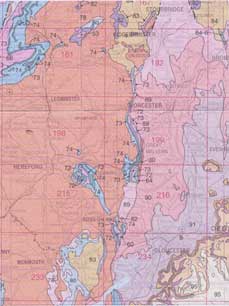
Complexity and uniformity
The next highlight of our expedition was Loxter Ashbed Quarry, opened up since the time of the 2010 walk. Mandy from the Earth Heritage Trust was on hand to help us interpret what we saw, not least in suggesting that what looked like a perfectly obvious anticline is indeed an anticline, but not as obvious as we thought its orientation. Other features such as an obliging trilobite and the bands of bentonite were also highlighted. Generally, though, the quarry is not particularly fossiliferous and serious searching on the part of members of the group proved this to be correct. The local members of the Earth Heritage Trust have done and continue to do a splendid job in keeping the face of the quarry clear of vegetation and maintaining it safely.
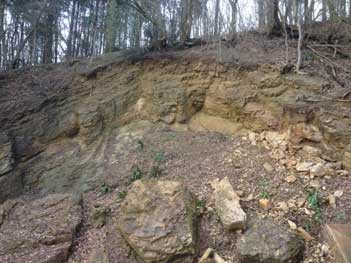
Yes it’s an anticline, but in what direction?
From the quarry we passed through the road cutting showing exposure of Aymestry limestone to the right and Upper Ludlow shale to the left before taking the field footpath which, according to the map, and in common with a number of other roads and paths in the area, obligingly followed the line of a fault through further ridge-and-vale landscape. Finally we returned to the former bed of Mathon lake, noting the indeterminate drainage arising from this now being the watershed between south-flowing streams following the pre-glacial route of the river, and the northward route now taken by Cradley brook following its blockage by ice.

Our final view of ridge-and-vale
The last leg of our route took us by car to the Chase Inn where earnest discussion of geological phenomena did not quite manage to divert us from enjoying our lunch.